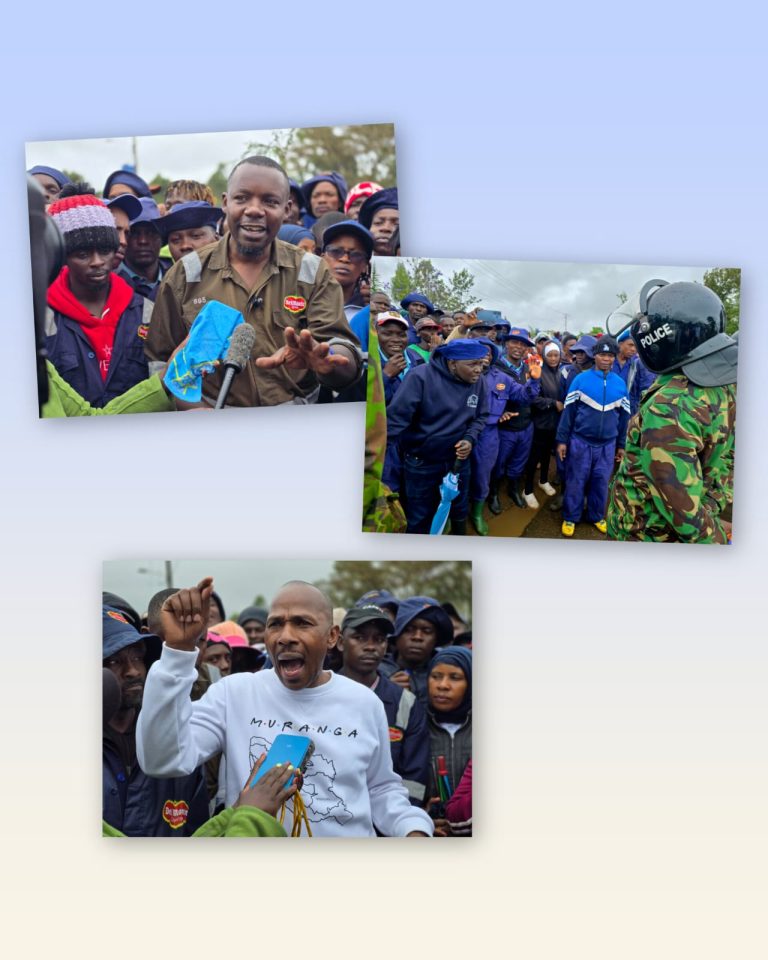
Protesting Del Monte Kenya workers
Del Monte Workers Protest Over Pineapple Theft, Insecurity
Thousands of Del Monte Kenya Limited workers on Friday downed their tools and staged protests along the Thika-Murang’a and Thika-Garissa highways over rising pineapple theft, insecurity and declining work opportunities.
The workers accused criminal gangs of invading the company’s plantations, stealing pineapples in large quantities and assaulting employees, including women, warning that the incidents had disrupted production and threatened their livelihoods.
They said the theft had reduced operations at the company’s cannery, with some employees now working only one day a week, leaving families struggling to afford food and pay school fees.
Meshack Owino, the head of employee representation, said workers had been forced to demonstrate after the security situation deteriorated despite a new security arrangement launched by Inspector General of Police Douglas Kanja and Deputy Inspector General of Police Gilbert Masengeli.
Owino alleged that organised cartels were behind the theft, with stolen pineapples finding their way into foreign markets, including Dubai and Israel. He called for sophisticated investigations to dismantle the networks, claiming containers and storage facilities were being used to facilitate the trade.
“We normally don’t come out to demonstrate, but the current situation has forced us to do so. We have seen a level of insecurity we have never experienced before, including destruction of property and harassment of women working on the plantation,” he said.
Francis Mwangangi, the chief shop steward of the Kenya Plantation and Agricultural Workers Union at Del Monte, said the theft had drastically reduced working days, particularly for employees involved in pineapple processing.
He claimed that gangs were entering the plantation on motorcycles, with more than 200 motorcycles allegedly ferrying stolen produce out of the farm. He also accused the intruders of assaulting workers and intimidating women employees.
Mwangangi questioned the effectiveness of security arrangements involving police and private guards, alleging that workers received delayed responses when reporting theft incidents.
He appealed to President William Ruto and Interior Cabinet Secretary Kipchumba Murkomen to intervene, warning that continued disruption of operations could threaten thousands of jobs and government revenue.
“If Del Monte closes, where will the government get the tax revenue it receives? Have thieves started paying taxes?” he posed.
Kakuzi-Mitubiri MCA and Deputy Majority Whip Stephen Muigai joined the workers, urging the government to protect the company and its employees.
Muigai said the escalating theft threatened a major employer whose operations supported thousands of families in the region. He warned that the alleged gangs could grow into organised criminal groups if security agencies failed to act.
“Del Monte has employed thousands of people. We don’t want to go looking elsewhere for the jobs the government talks about when we already have jobs here,” he said.
He said workers should not be forced to confront suspected thieves themselves and called for the same seriousness applied to other forms of theft to be extended to pineapple theft.
At the end of the demonstrations, Mwangangi presented a petition to Ithanga-Kakuzi Deputy County Commissioner James Wambua, who received it on behalf of the government and promised to forward it to the relevant authorities.
Wambua urged the workers to return peacefully to work, assuring them that their grievances would be addressed and feedback provided.
The protests come months after Kanja launched the Administration Police Service Critical Infrastructure Protection Unit – Del Monte Sector in April 2026 to strengthen security around the company’s investments, employees and neighbouring communities.
The unit was expected to improve surveillance, enhance rapid response and ensure sustained security presence following concerns raised during the Jukwaa la Usalama forum in Kiambu.
Kanja said the initiative was part of efforts to promote intelligence-led policing and more coordinated, community-driven security responses.ends
About The Author