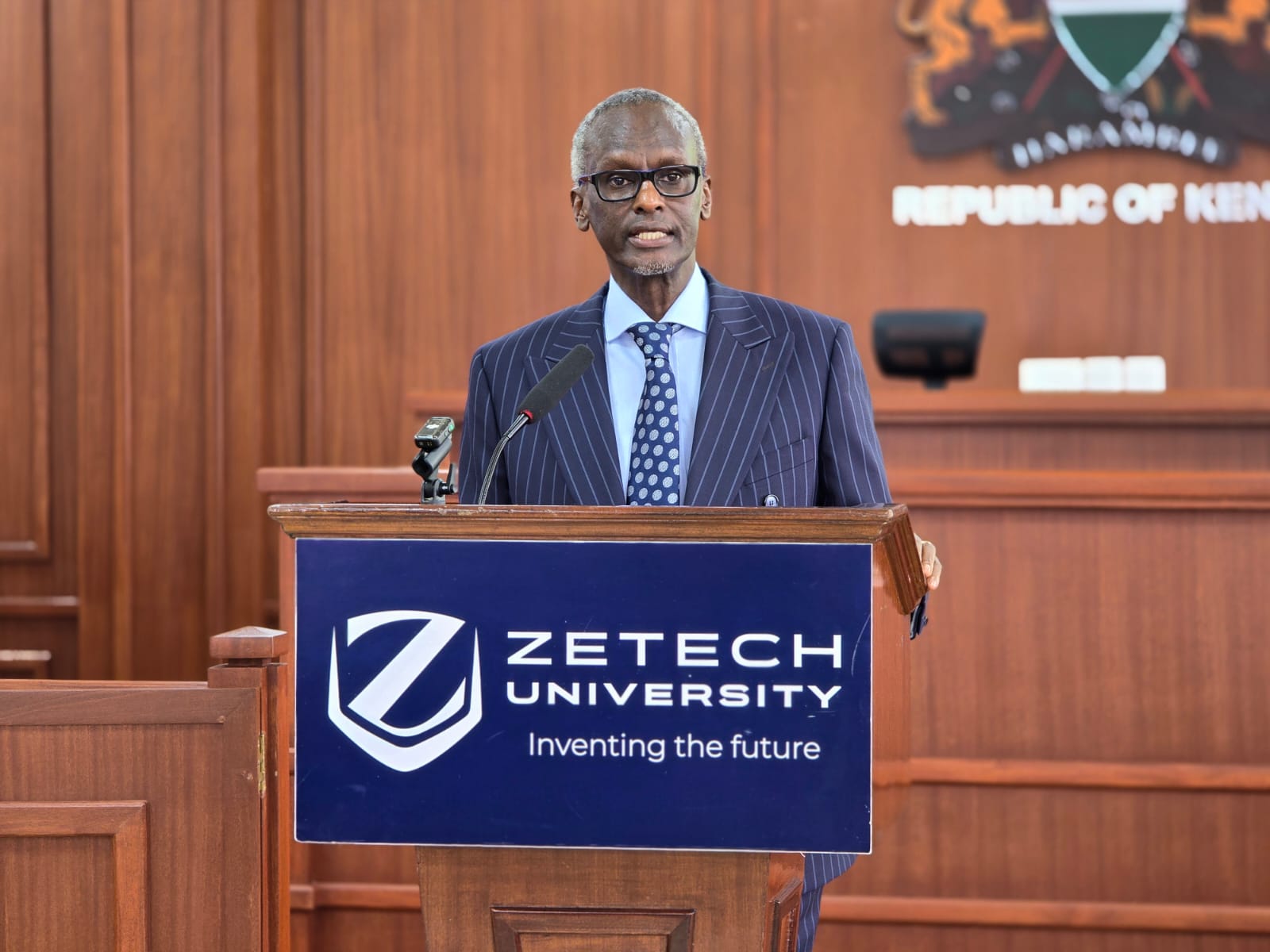
Supreme Court Judge Isaac Lenaola addressing guests after the launch of the law school and Bachelor of Laws programme at Zetech University’s Technology Park, Mang’u Campus in Kiambu County.
Supreme Court Judge Isaac Lenaola has raised concerns over the growing threat of misinformation and emerging technologies such as artificial intelligence to democratic processes, warning that the country must prepare itself to confront the dangers posed by disinformation and deepfakes.
Speaking on Friday during the launch of the law school and Bachelor of Laws programme at Zetech University’s Technology Park Mang’u Campus in Kiambu County, Justice Lenaola said the age of misinformation and fake news has raised serious questions about the place of truth and accuracy in society.
His remarks come at a time when concerns are growing over the use of hired goons by politicians during political contests, a trend observers warn could heighten tensions as Kenya heads toward the next general election.
“In this era of misinformation, disinformation and fake news, where are truth and accuracy? Sometimes what appears to be truth and accuracy is no longer real,” he said.
The judge noted that the rapid advancement of artificial intelligence has introduced complex challenges that legal practitioners and judicial officers must be ready to confront.
Justice Lenaola, who is part of a group of African judges studying the impact of AI on elections across the continent, posed a stark question:
“We are asking ourselves a simple question. What will happen in an election in an African country where one candidate uses deepfake technology to disenfranchise an entire section of voters?”
He painted a hypothetical scenario where voters in a particular region receive manipulated messages on the eve of an election, warning of impending violence.
“Imagine the night before the election, all phones in a particular area are accessed and voters receive messages claiming there will be violence, that women will be raped and houses burned simply because the region does not support a certain candidate,” he said.
Justice Lenaola explained that such targeted misinformation could frighten residents into staying away from polling stations, effectively suppressing votes in that area while other parts of the constituency proceed to vote.
“The result is that the whole area does not vote because they have been affected by misinformation and disinformation,” he said.
He challenged law students, legal scholars, and practicing advocates to think critically about how courts would handle such cases.
“As a judge sitting in court, how would you handle that evidence in determining the legitimacy and legality of an election?” he asked.
“These are realities we must continue to engage with. Lawyers, students, teachers, and those already in practice must begin answering these questions,” Justice Lenaola emphasized.
The launch of the law school was also hailed by university leadership and legal education regulators.
Deputy Vice-Chancellor for Academic and Student Affairs at Zetech University, Prof Alice Njuguna, described the establishment of the law school as a major milestone.
“The launch of the law school is part of the university’s broader vision to nurture competent professionals who can respond to emerging societal challenges and contribute meaningfully to the justice sector,” Prof Njuguna said.
She added that the institution has invested in qualified faculty, modern learning facilities, and partnerships to ensure students receive a holistic legal education.
Chief Executive Officer of the Council of Legal Education, Prof Jack Mwimali, said the accreditation of the Bachelor of Laws programme demonstrates the university’s readiness to meet national standards in legal training.
“The legal profession demands discipline, ethical conduct, and dedication to the rule of law. Students must therefore take their training seriously as they prepare to serve society,” he said.
Ends
About The Author