Wesley Njenga, team lead of Ecoscrubber, a group of MKU students who won a finalist award for their ground breaking innovation in pollution control in Michigan, USA recently.
MKU’s global technology award winning teams Caution youth on misuse of Artificial Intelligence
Mount Kenya University (MKU) teams of students and their instructors who won global awards in America and China recently have warned young people on the continuing misuse of Artificial Intelligence (AI) technology.
A team of four MKU students has put the institution on the spotlight after securing a finalist award at the prestigious Wege Prize 2026, held recently in Grand Rapids, Michigan. The team, represented by Mr. Wesley Njenga, walked away with $2,500 (Sh323, 650) for their groundbreaking innovation, EcoScrubber, a hybrid emission control and carbon-capture system that transforms toxic pollutants from incinerator chimneys into usable construction materials.
The Wege Prize, organized by Michigan-based Ferris State University’s Kendall College of Art and Design (KCAD), challenges university students from around the world to collaboratively solve complex, systems-level problems by developing products, services, and business models based on the three core principles of the circular economy: eliminating waste and pollution, keeping products and materials in circulation, and regenerating natural systems.
This year’s competition attracted 87 teams from over 30 countries, representing nearly 200 academic disciplines. Through a rigorous, iterative process spanning multiple phases, teams received in-depth feedback from expert judges, refining their rough concepts into fully-fledged frameworks. From this competitive field, the MKU team comprising Mr. Wesley Njenga, Mr. Franklin Mwendwa, Mr. Elijah Maina, and Mr. Ejike Chinyere, all from the School of Public Health emerged as one of five teams invited to pitch in the United States.
The inspiration behind EcoScrubber came from an ordinary yet powerful moment on a road in Thika. The students witnessed a truck belching thick black smoke while passersby struggled to breathe. That encounter sparked a compelling question: could those harmful emissions be captured and repurposed rather than left to pollute the air? The team took that question back to the university’s Innovation and incubation centre, where they began turning the concept into reality.
Speaking during the award ceremony, team lead Wesley Njenga expressed pride in how the University has supported their journey to the global stage. “We were honoured to showcase home-grown solutions like Ecoscrubber, as well as compete with the best in the world,” he said.
The student was accompanied by the Institutions Head, Innovations, Intellectual Property and community Engagement, Mr. Donatus Njoroge who provided guidance throughout the pitch sessions. “We are proud of their progress so far and we will continue to offer technical support, and global exposure on their path to commercialization,” Mr. Njoroge after the win.
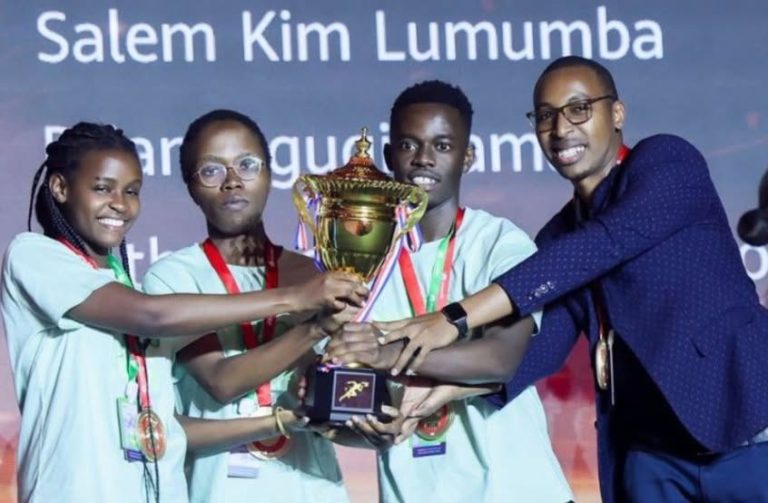
In Shenzhen, China, a Kenyan team including an MKU student secured a historic victory at the Huawei ICT Competition Global Finals, beating over 220,000 participants worldwide. In a historic victory for East Africa, a Kenyan trio have won the grand prize at the Huawei ICT Competition Global Finals in Shenzhen, China.
Catherine Atieno of JKUAT, Salem Kim of Machakos University and Brian Ngugi of Mount Kenya University, guided by instructor Kevin Tuei beat more than 220,000 students worldwide to secure the highest honour. This is the first time a team from Kenya has clinched the grand prize after years of regional success and participation in the competition.
The Huawei ICT Competition Global Finals were held in Shenzhen, China. More than 220,000 contestants came from universities and colleges from across the world.
The event, organised annually in collaboration with universities worldwide and UNESCO’s International Bureau of Education (UNESCO-IBE), is regarded as one of the most prestigious global platforms for emerging technology talents. The competition assesses participants’ knowledge and practical expertise in advanced ICT fields, including 5G, cloud technologies, networking and artificial intelligence.
Congratulating all the various the winners after their return to Kenya, Mr Njoroge, said the institution supports students with innovative ideas to commercialise them, to turn them into businesses. ‘‘Our work revolves around helping students gain access to the training and opportunities locally and abroad, and also gain access to funding to support their innovations,’’ he said.
In the last one year, MKU has had various students competing locally and globally and winning different awards. ‘‘Some students who had traveled to China to participate in Huawei ICT competition and we’re really proud that they matched the global winners. Another group of students went to USA and they emerged as one of the winners of the Wage Prize 2026. We are also conducting various trainings and we have a couple of students in Germany under innovation exchange programmes,’’ he added.
Mr Njoroge said while Kenya has problems with jobs, MKU is committed to creating jobs. We are able to produce workforce that can compete with the best globally. ‘‘We are supporting them in every aspect, plugging in resources and using the grants they are getting from external donors in competitions to improve on the Minimum Viable Product (MVP) so as to commercialise them,’’ he said.
Mr Njoroge called upon companies, corporates, who have challenges in their processes, in their operations, to partner with MKU’ s Innovation and Equipment Centre, where the institution can use the skills that built over time to solve new processes.
He asked university students to leverage on research, innovation to get businesses, to employ others way before they even finish their studies. ‘‘Students are the best innovators, with fresh minds, they’ve got the capability, the opportunity. So, we advise that they use their time well, they use their resources, they use their skills to start businesses way before they complete their studies,’’ he said.
Mr Njoroge said the Kenya National Innovation Agency has been doing a great job in supporting innovators, but the government should plug more funding into the innovation pipeline. ‘‘We call upon the government to look into the universities, look into their ideas, fund research and increase funding for innovators to help the country come out of the situation of joblessness.
AI
Mr Njoroge warned against a growing misuse of Artificial Intelligence (AI), especially ahead of the 2027 General Election. Some repercussions of using AI negatively, he cautioned, is that you cannot differentiate between truth, half-truths and even false information.
He called on the youth to use AI responsibly. ‘‘We call upon students to use AI for their benefit. AI is here with us. It is changing the way we do our things. It is supposed to improve our processes, supposed to improve how we do our things. So, we call upon young people to be able to use AI to get jobs, to improve their processes and to make their learning and even their research simpler,’’ he said.
‘‘So, by leveraging on using AI correctly, you’re able to separate whatever is truthful, whatever is false, and you’re able to get accurate information, especially as you’re approaching one’s election. So we call upon young people to be able to use AI properly, not to spread rumours, not to spread false information’’, he added.
Brian Ngugi, a student at MKU who took part in the Huawei event, called the success a long journey. He asked IT learners not to ignore competitions. He said he joined the Huawei competition to better himself. ‘‘It’s a big achievement. It opens doors for internships,’’ he noted.
He advised students to keep trying, not give up easily. ‘‘Do something…. try from where you are. Do something. The world is full of opportunities,’’ he said.
Ngugi also noted that AI is being used negatively, for bad things such as manipulation of videos, alteration information, data and photographs. ‘‘Students should leverage on AI to mine data,’’ he added
Wesley Njenga, a founder member of Team EcoScrubber, which had travelled to USA, praised Mr Njoroge for his guidance. ‘‘He was guiding me all through, telling me what to do right and wrong, and clearly it paid off. For winning the finalist award, we were able to get some seed funding, which we were going to use to finalise the MVP. We are just one to two months before the finalization of the MVP,’’ Njenga said.
He encouraged the government to partner with institutions like MKU which has a working innovations hub already. ‘‘The government is a key stakeholder in young, budding innovations and startups which really need to access funding, access experts and access policy makers who are all close to the government,’’ he observed.
His project had to use lots of data, information that is not easily available. ‘‘We used AI. We are the next generation of solvers of global challenges. AI also helps in validating data. A tool every young person should be utilizing. The MKU innovation hub made things so much easier,’’ he said.
Industry leaders and education stakeholders have hailed the achievement as a strong affirmation of Kenya’s growing capacity to compete globally in technology and innovation. The wins also highlights the increasing role of young Africans—and women in particular—in shaping the future of digital transformation.
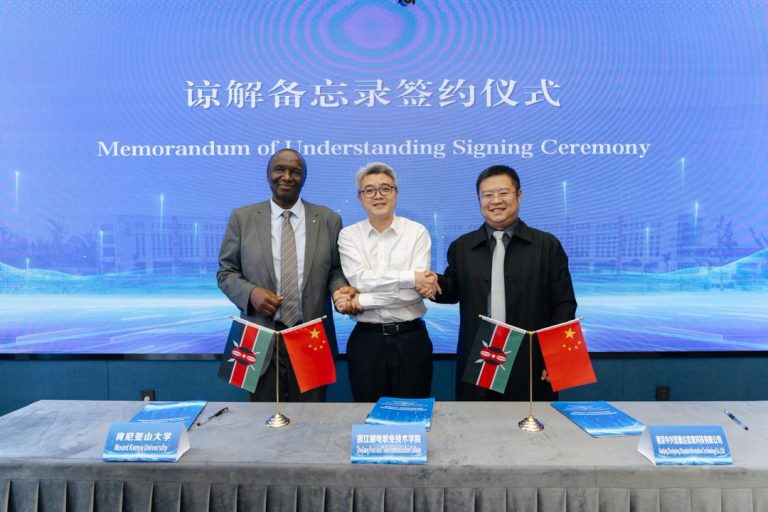
Together, the MKU partnership and the global competition triumph signal a transformative moment for technology education in Kenya. They demonstrate the country’s commitment to equipping learners with future-ready, industry-aligned skills while strengthening international collaboration.
As MKU continues to expand its global partnerships and Kenyan students excel on the world stage, the nation is positioning itself as a leading hub for ICT talent development, innovation, and digital transformation in Africa.
Ends
About The Author