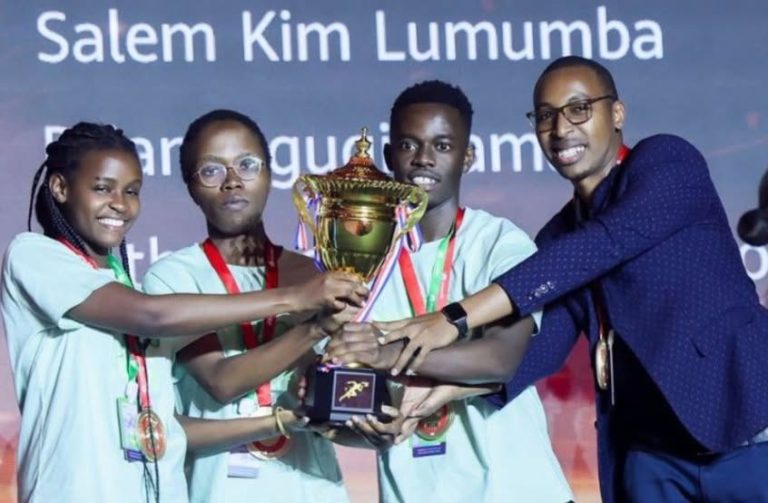
Some the students and university researchers from four African countries who participated in the innovation competition in Germany
Two Mount Kenya University (MKU) student innovators have emerged as the top investment-worthy innovators during a prestigious competition held in Leipzig, Germany held last week.
This milestone was reached during the African Centre for Career Enhancement a Skills Support (ACCESS) programme, where students from five African university participated in a rigorous two-week entrepreneurship training at the SEPT Competence Centre at Leipzig University. Esbon Ogeto and Bettinah Maruti’s start-up project, EcoBlu, took first position as an investment worthy project.
The programme included sessions on business planning, market potential, financial modelling and pitch development, culminating in a high-stakes pitch presentation where “EcoBlue” stood out as the most promising start-up.
Dr. Henry Yatich, ACCESS Project Coordinator at MKU, said Esbon and Bettinah’s success reflects the institution’s commitment to nurturing entrepreneurial talent and addressing employability challenges among African youth. “Through Access Kenya, MKU continues to build the next generation of innovators by offering mentorship, training, and global exposure,” he said.
To support the realization of their vision, the “EcoBlue” team will receive ongoing assistance from MKU’s Incubation and Innovation Centre, including prototype development and testing, guidance on securing a utility model and patents from Kenya Industrial Property Institute (KIPI as well as strategic support to access international markets, including in Europe.
The AGEA Start-up Class, a fully funded component of the ACCESS 2.0 project, was held in Leipzig, Germany, from September 3rd to September 13th, 2025. The event supported 12 young innovators from five African universities in developing innovative, market-ready business models from their science-based start-up projects.
The students and researchers came from universities in Kenya, Ghana, Benin, and Rwanda. For 10 days, these aspiring entrepreneurs immersed themselves in an environment of learning, coaching, and cross-cultural exchange that pushed them to rethink, refine, and reimagine their businesses.
The seven participating start-ups were: Ecoblue (MKU, Kenya); Harcourt Agri-Eco Farm (Jomo Kenyatta University of Agriculture and Technology, Kenya); ObstaMed (Kwame Nkrumah University of Science & Technology, Ghana); WaxFarm (University for Development Studies, Ghana); BIOS Benin (University of Abomey Calavi, Benin); Tak-Avipack (University of Abomey Calavi, Benin) and DailyPlus (Rwanda).
The competition was part of the ACCESS 2.0 project, a European Union-funded initiative by Leipzig University and its African partners to promote entrepreneurship and bridge the gap between scientific research and market-ready applications. It brought together students and researchers from Africa to train them in developing innovative business models.
Beyond the technical training, coaching sessions gave space for one-on-one guidance. Teams refined their strategies, rehearsed pitches, and received feedback tailored to their contexts. The final days were dedicated to the Pitch Presentation, where each team stepped forward, presenting not just a business idea but a refined vision backed by research, strategy, and knowledge from the training.
The programme was not confined to classrooms as participants engaged with Leipzig University’s SMILE start-up community to exchange experiences with local start-up teams such as TalentNet.AI and Hybeam. They also attended the iN4iN International Conference.
Cultural activities, from walking tours of Leipzig to networking dinners, created bonds that went beyond business. They also had the chance to visit the German capital as they participated in the IFA-Berlin international fair, the world’s leading trade fair that showcases the latest trends and innovations in areas like smart home technology, audio, AI, and more, providing a platform for leading brands, start-ups, and industry experts to connect and demonstrate future technologies.
Dr Yatich said in line with its mission to scale innovation, MKU and its 10 affiliate universities are organizing a national business innovation challenge titled: “Innovate for Impact: Scaling Kenyan MSMEs through SDG 9” from mid next month.
“This challenge invites student applicants to present solutions that empower micro, small, and medium enterprises (MSMEs) in Kenya. Interested students are encouraged to submit their applications via MKU’s official Facebook page. “Let’s continue to celebrate and support the brilliance of our students as they transform ideas into impactful ventures,” said Dr Yatich.
Ends
About The Author